What Twelve Days at ICAR-DMR Actually Taught Us
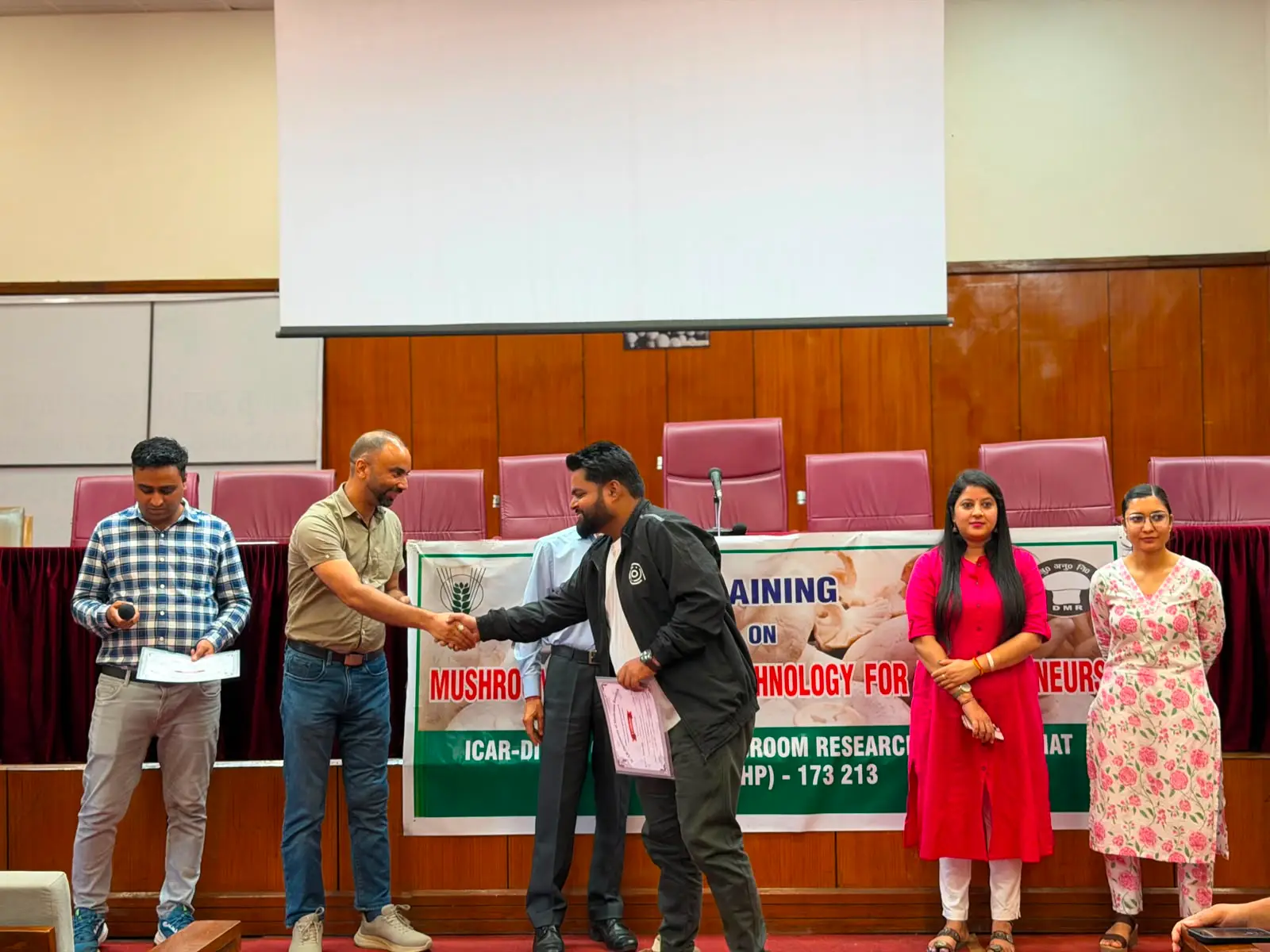
Most people who buy a bag of dried mushrooms from us never ask where we learned what we know. Fair enough: you're buying cookies and soup mix, not a syllabus. But since we put "trained under ICAR-DMR" on nearly every page of this site, it's worth actually explaining what that means instead of leaving it as a badge nobody can verify.
ICAR-DMR is the Directorate of Mushroom Research, part of the Indian Council of Agricultural Research, based in Chambaghat, Solan, Himachal Pradesh. It's the country's apex research body for mushroom science: the place that develops spawn strains, studies cultivation technology, and trains the scientists who eventually go on to teach at state agricultural universities. We didn't invent our knowledge of mushrooms from YouTube and enthusiasm. We sat through a twelve-day residential programme there, alongside working scientists, and came out the other side with a certificate and, more usefully, a working understanding of why mushrooms behave the way they do.
What the syllabus actually covered
The programme isn't a single lecture on "mushrooms are healthy." It's broken into blocks taught by different scientists, each specialising in one slice of the science:
Cultivation biology and species selection. Sessions covered the biology of Pleurotus (oyster), Agaricus (button), Calocybe (milky), Volvariella (paddy straw), Lentinula (shiitake) and the medicinal genera (Ganoderma and Cordyceps), including which species suit which Indian climate zone. Oyster and milky mushrooms, for instance, tolerate the kind of summer heat that would kill a temperate species like button mushroom outright, which is exactly why button cultivation in northern India is seasonal and oyster cultivation isn't.
Nutritional and medicinal value. A full session, taught by a principal scientist, went through the composition of mushrooms in real numbers: protein averaging 30-35% of dry mass, fat under 2%, no starch, high dietary fibre, and a mineral profile heavy in potassium, selenium and copper. We left that session able to explain, with real figures, why mushroom protein is a reasonable food category rather than a marketing claim. We've written more on that separately.
Post-harvest handling. This was one of the more practically useful blocks. Fresh mushrooms are roughly 90% water, have no protective cuticle like a fruit skin, and respire fast, which is why a fresh mushroom left on a counter goes slimy in a day or two while a tomato survives a week. The training covered correct harvest timing (mature, not over-mature), why washing before storage shortens shelf life, cold-chain temperatures (0-4°C for most species, 10-12°C for paddy straw specifically, which is more heat-sensitive to chilling injury), and packaging formats used commercially: perforated polypropylene pouches, PVC-wrapped punnets, and so on.
Pest and disease management. A less glamorous but important session on sciarid flies, phorid flies, mites and nematodes: the pests that actually cause crop losses in mushroom units, most of them tiny flies that most people have never heard of. Understanding this matters less for a snack company like us and more for the growers and would-be FPOs we consult with, who need to know that a mushroom unit's biggest threat usually isn't disease in the dramatic sense: it's a fly infestation that spreads through the compost.
Marketing and business structure. A session taught by a scientist who has advised on mushroom marketing policy covered the practical side of building a mushroom business: understanding local supply-demand balance before scaling, the difference between low-volume high-margin and high-volume low-margin strategies, the role of FPOs (Farmer Producer Organisations) and cooperatives in aggregating small growers into something buyers can deal with at scale, and how to list a product on e-commerce platforms. This is the part of the training that most directly shapes the business support consulting we now offer.
Why this matters more than it sounds
Here's the honest version: a certificate from a government research institute doesn't make our cookies taste better. What it does is give us a floor under every claim we make. When we say reishi is "traditionally used as a decoction, not eaten fresh," that's not us hedging: that's literally what we were taught, because reishi's woody texture means fresh consumption isn't practical, whatever a supplement bottle's label implies. When we say cordyceps militaris in our powder is lab-cultivated rather than wild-harvested, that's because wild Himalayan cordyceps (Ophiocordyceps sinensis, a genuinely different species from the cultivated Cordyceps militaris we use) is now scarce enough to sell for more than gold by weight, and no honest supply chain claims otherwise at consumer prices.
We're not scientists ourselves: nobody at Shroomly holds a PhD in mycology. What the ICAR-DMR training gave us is closer to a serious amateur's grounding: enough to know what we don't know, enough to spot a bad claim when we see one on a competitor's label, and enough to have an actual conversation with a customer who wants to know whether mushroom protein is "real" protein (yes, complete with nine essential amino acids, though slightly deficient in sulphur-containing ones like methionine, which is why we don't market mushroom powder as a total protein replacement, only as a contributor).
What it doesn't make us
It's worth being precise about limits, because overclaiming credentials is exactly the kind of thing we criticise elsewhere on this site. The ICAR-DMR programme is a structured training course, not a research degree. We didn't run experiments there or publish anything. What we got is a solid, current, science-backed foundation: the same one that underlies extension work done across Indian agricultural universities, applied by us to a food and consulting business rather than to a research career.
If you're evaluating whether to trust a mushroom brand's health claims (ours or anyone else's), the honest advice is to ask the same question we'd want asked of us: where did this specific claim come from, and does the person making it actually understand the biology behind it, or are they repeating something they read on a supplement bottle. We try to answer that question plainly every time it comes up, on this blog and in the business consultations we run for people starting their own mushroom ventures. More on who we are and how this training shaped Shroomly is on the about page; the mushroom guide has the species-level numbers this training gave us.