Why We Use Mushroom Powder, Not Flavouring, in Our Cookies
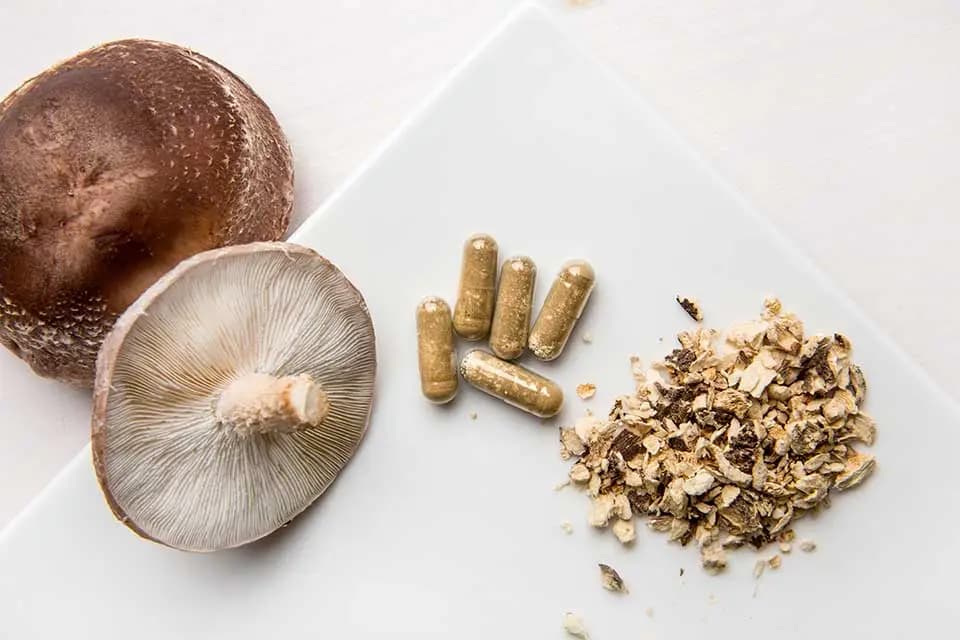
A fair question we get from people looking at our cookie packaging for the first time: is there actually mushroom in this, or is it just flavoured to taste vaguely earthy? It's a fair question because the supplement and snack industry has a real history of "mushroom-flavoured" products that contain flavouring compounds and nothing else. Here's the honest answer for our own products, and the reasoning behind why we build them the way we do.
The fresh-versus-dried math that decides everything
We've written elsewhere about the nutrition numbers, but the short version bears repeating here because it's the entire reason our manufacturing process looks the way it does: fresh mushrooms are roughly 90% water. Protein content on a fresh basis works out to somewhere between 2 and 4 grams per 100g depending on species. That's a real but modest contribution: genuinely not enough, in a 20-gram cookie made mostly of flour, sugar and fat, to register as meaningful nutrition.
Dry-weight protein content, by contrast, runs 30-35% across most cultivated species, an order of magnitude higher. The entire difference between those two numbers is water, and removing that water through drying is what makes mushroom a viable functional ingredient in a baked snack rather than a garnish. This is the actual mechanism, not a manufacturing trick: dry, then mill into powder, and you've concentrated the mushroom's nutritional density into a small, stable, easily dosed ingredient that a cookie or bar recipe can actually incorporate at a meaningful percentage.
What "mushroom powder" means in our process
Our process starts with mushroom (typically button or oyster depending on the product line) that's been properly harvested at correct maturity and dried using controlled methods that preserve as much of the nutrient profile as reasonably possible, rather than sun-dried in an uncontrolled way that risks contamination or inconsistent moisture content. The dried mushroom is milled to a fine powder, tested for moisture content (dried product needs to hit a low enough moisture level to be shelf-stable, generally in the low single-digit percentage range, otherwise you've just built a slower-motion spoilage problem into your finished product), and then incorporated directly into the base recipe: folded into cookie dough alongside the flour, blended into nutribar mixes with oats and nuts, or used as a flavour-and-nutrition base in our soup mixes.
This is a meaningfully different process from adding a mushroom flavouring extract, which is typically a compound designed to replicate umami or earthy taste notes without carrying the fibre, protein or mineral content of the actual dried ingredient. Flavouring is cheaper, more shelf-stable, and easier to dose consistently, which is exactly why it's tempting for a manufacturer trying to make health claims without the cost of a real functional ingredient. We use real milled mushroom powder specifically because the entire premise of our snack line is that a cookie or bar can be a genuine contributor to fibre and protein intake, not just something that tastes vaguely mushroom-adjacent.
Why this shows up differently across our product range
We don't use a single formulation across every product, because different bases suit different nutrition goals, and being specific about which is which matters more to us than a blanket "healthy" label:
Millet, ragi, jowar and bajra-based cookies lean on the natural gluten-free, fibre-forward profile of Indian millets, with mushroom powder adding protein density and a subtly savoury depth that balances sweetness, which is part of why our ragi chocolate and bajra cashew cookies read as less cloying than a standard butter cookie.
Nutribars built on oats, nuts and dried fruit use mushroom powder specifically for its protein contribution alongside the naturally higher fat and fibre content of the nut and seed base: the mixed-nut bar in our range is positioned deliberately as a higher-protein option within the line for that reason.
Seasoning blends use mushroom powder for its natural umami contribution: mushrooms contain glutamate compounds that deliver savoury depth without needing added MSM or heavy salt loading, the same principle that makes dried shiitake a classic broth ingredient in East Asian cooking.
Soup mixes use mushroom powder as both flavour base and thickening body, closest in spirit to a traditional dried mushroom stock, just formatted for a quick hot-water preparation.
The honest limits of what a cookie can do
We'd rather be precise than let this read as bigger than it is. A 150g packet of ragi chocolate mushroom cookies is not a protein supplement, and we don't market it as one. It's a snack that happens to carry more fibre and a modest protein boost compared to an equivalent conventional cookie, built on a real ingredient rather than a flavouring shortcut. If you're trying to hit a specific daily protein or fibre target, our dried mushroom and cordyceps powder products are the more concentrated route; the snack line is meant to make everyday eating slightly better, not to replace deliberate nutrition planning.
That distinction, between "genuinely improved everyday snack" and "nutritional intervention," is one we try to keep clear in our own marketing, partly because overclaiming what a cookie can do is exactly the kind of mushroom-industry exaggeration we spend a fair amount of this blog correcting in other contexts. It would be strange to hold ourselves to a lower standard than we hold everyone else to.
Quality control: the part customers never see
Behind every batch of cookies or nutribars is a set of quality checks that don't show up on the packaging but determine whether the final product is safe and consistent. Incoming dried mushroom is checked for moisture content before milling: too high, and the powder risks mould growth in storage; properly dried, it should sit in a low single-digit moisture percentage, stable at room temperature for extended periods. Milled powder is checked for particle consistency, since an unevenly milled powder can create texture problems in a baked product: visible gritty specks in a cookie, for instance, rather than a smooth incorporation into the dough. And because we operate under an FSSAI licence, our processing follows documented hygiene and batch-testing standards rather than informal home-kitchen practices, which matters more than most customers realise when they're deciding which mushroom snack brand to trust with a daily habit.
Why this approach costs more, and why we think it's worth it
Being transparent about our process also means being transparent about cost: real dried mushroom powder, properly sourced, dried and milled, costs meaningfully more than a flavouring compound designed to mimic the same taste. This shows up in our pricing relative to conventional cookies or bars that use no mushroom at all, and it's a fair question if a customer wonders why our products aren't priced at the very bottom of the snack category. Our answer is straightforward: we'd rather charge honestly for a product that does what it claims than compete on price by quietly substituting flavouring for substance. That's a slower way to build volume, but it's consistent with everything else we say on this site about traceability, credentials and straight answers over sales pitches. Browse the full cookie and nutribar range to see where this process actually ends up, and the mushroom guide for the species-level nutrition numbers behind it.