Are Mushroom-Powder Snacks Actually a Nutrition Upgrade?
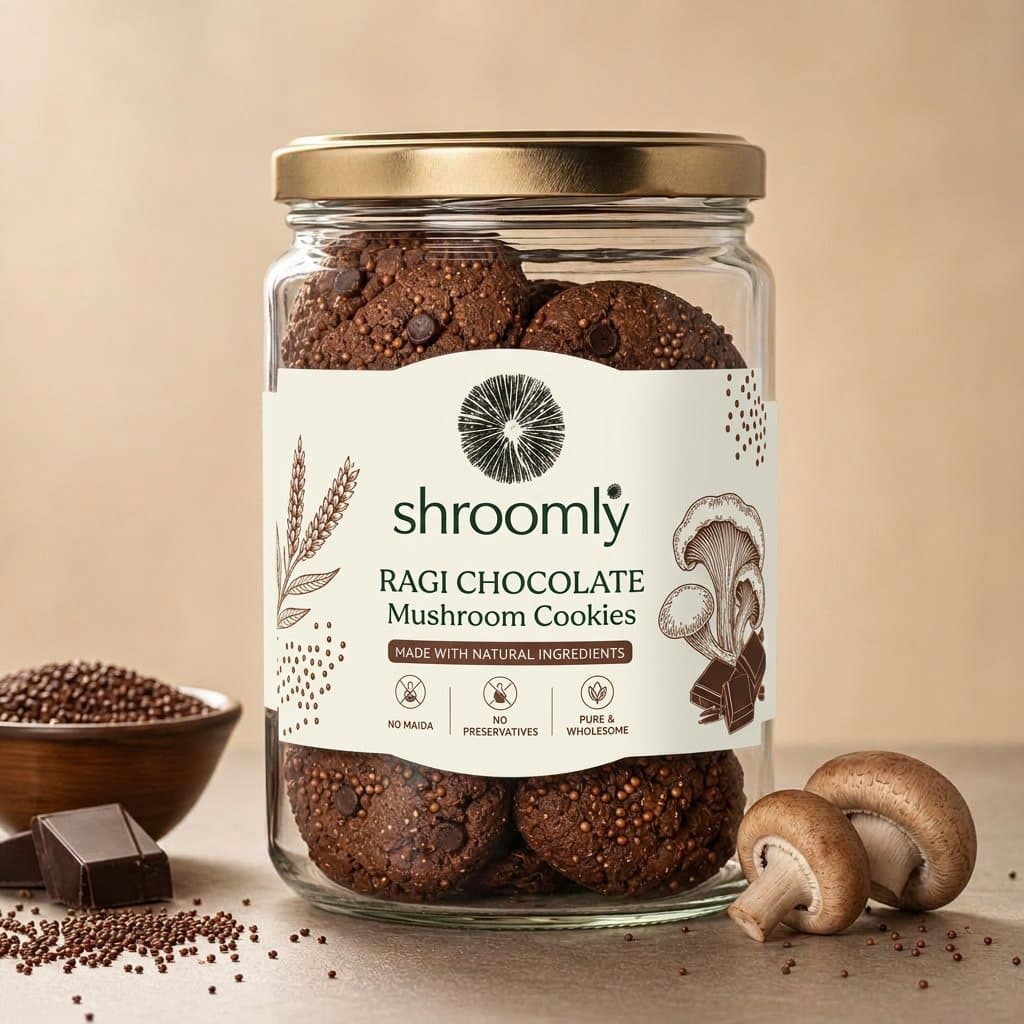
We sell mushroom-powder cookies, nutribars, soup mixes and seasoning ourselves, so we're aware this question can sound like it's coming from someone with a stake in the answer. We'd rather address it directly than avoid it: is a mushroom-powder snack actually a meaningful nutrition upgrade over a regular one, or is "mushroom" mostly doing marketing work on the packaging? The honest answer is: it depends heavily on dose, and a lot of what's on shelves (ours included, at the scale a single cookie operates at) is a modest improvement, not a nutritional intervention. Here's how to actually evaluate it.
The core problem: dose is everything, and packaging rarely tells you the dose
Mushroom, fresh, is roughly 90% water. That means fresh-weight protein content looks modest (2 to 4 grams per 100g depending on species), nowhere near enough, folded into a 20-gram cookie made mostly of flour, sugar and fat, to register as meaningful nutrition on its own. This is exactly why any manufacturer serious about mushroom as a functional ingredient uses dried, milled powder instead of fresh mushroom or, worse, flavouring: dry-weight protein content across most cultivated species runs 30-35%, an order of magnitude more concentrated. Drying is what makes mushroom powder capable of contributing anything measurable to a snack at all.
But even concentrated powder is only meaningful if the finished product uses enough of it. A cookie, bar or seasoning blend that includes a small percentage of mushroom powder alongside a base of flour, sugar, oil and other ingredients is going to deliver a correspondingly small nutritional contribution: real, but modest. This is the single most important thing to understand before evaluating any mushroom snack claim: "contains mushroom powder" tells you almost nothing about magnitude. A product with 15% mushroom powder in its recipe and one with 1% can carry an identical claim on the front of the pack.
Most brands, ourselves included, don't print the exact percentage of mushroom powder in a recipe on the front label: it's treated as proprietary formulation detail, the same way a bakery doesn't publish its exact flour-to-sugar ratio. That's a legitimate business practice, but it also means a shopper genuinely can't verify dose from packaging alone in most cases, which is exactly why skepticism is the right default response to any specific health claim on a mushroom snack.
What might actually carry over, and what almost certainly doesn't
Fibre is one of the more plausible carryovers, because whole mushroom powder (not an isolated extract) retains the structural fibre (including beta-glucans) present in the dried mushroom. If a snack uses a meaningful percentage of mushroom powder in its recipe, a measurable fibre bump is realistic, and it's one of the more legitimate reasons a mushroom cookie could out-fibre a plain one, especially when paired with a naturally fibre-forward base flour like ragi, jowar or bajra.
Protein is a smaller and shakier story at snack-level doses. Even at concentrated dry-weight levels, the actual gram contribution from the mushroom-powder fraction of a 150g cookie packet or 40g bar is small relative to the product's total protein. Most of a nutribar's protein, realistically, is coming from its nuts, oats or seeds, not the mushroom powder fraction, even when the mushroom is a real and intentional ingredient. If a product is marketed primarily as a protein source on the strength of its mushroom content specifically, that claim deserves scrutiny.
Vitamin D is where skepticism should be highest. Mushrooms can carry vitamin D2, but it varies significantly by species and, critically, by whether the mushroom was exposed to UV light (sun or lamp) during growing or drying. A mushroom grown and dried without that exposure won't carry much D2 regardless of species. Unless a brand specifically states its mushroom was UV-treated and states an actual D2 figure for the finished product, "contains vitamin D" on a mushroom snack label is closer to a plausibility claim than a verified one. Don't treat a mushroom cookie as a vitamin D strategy without that specific evidence.
Minerals like potassium and selenium follow the same dose-dependency logic as protein: real in the raw ingredient, present in the powder, but diluted by the time you're talking about the mushroom-powder fraction of a snack-sized serving rather than a 100g research-reference portion.
Medicinal or "immune-boosting" claims, especially around adjacent ingredients like reishi or cordyceps, deserve the most skepticism of all. There's genuine research interest in compounds like beta-glucans and triterpenes from medicinal mushrooms, but the evidence base for health outcomes is still early, and it applies to studied doses of specific extracts, not to a small amount of powder folded into a cookie recipe. Any snack implying disease prevention or cure territory on the back of a mushroom ingredient is overreaching regardless of which brand is selling it.
How to actually read a mushroom snack label
A few practical habits cut through most of the marketing noise:
Check the ingredient list order, not just the front-of-pack claim. Ingredients are legally listed by descending weight. If mushroom powder appears near the end of the ingredient list, after several other bulk ingredients, that's a signal of a lower-dose formulation, regardless of how prominently "mushroom" features on the front of the pack.
Compare the nutrition panel to a plain equivalent, not to the marketing copy. If a mushroom cookie's fibre or protein number isn't meaningfully different from a regular cookie of the same size and base flour, the mushroom content isn't doing much nutritionally, whatever the packaging implies. It may still be a perfectly nice cookie, just not a meaningful upgrade.
Be specifically wary of "immune support," "boosts metabolism," or disease-adjacent language on a snack. These are the claims most likely to be marketing language riding on general mushroom-wellness sentiment rather than anything specific to that product's actual formulation or dose.
Treat whole milled powder and "extract" or "flavouring" as different things entirely. A flavouring compound can replicate mushroom's earthy or umami taste without carrying any of the fibre, protein or mineral content of the real ingredient. It's cheaper, more shelf-stable, and easier to dose consistently, which is exactly why it's tempting for a brand chasing a health halo without the ingredient cost. If a label doesn't specify actual mushroom powder (or specifies "mushroom flavour" instead), that's worth noticing.
When a mushroom snack is genuinely worth it, and when it's just a halo
A mushroom-powder snack is genuinely useful when you'd be eating that category of snack anyway (a cookie with tea, an energy bar before a workout, a soup on a cold evening) and the mushroom-powder version gives you a real, if modest, nutritional edge over the equivalent product with none. In that comparison, the mushroom content is a legitimate upside, not a scam, even at modest dose. It's a genuinely different claim to "this snack will meaningfully improve your health" or "this replaces a supplement": claims a snack, whatever its ingredient list, generally can't support.
It's not a substitute for whole dried mushroom or mushroom powder used directly and at a dose you control (stirred into dal, blended into a smoothie, added generously to a broth) if your actual goal is maximising mushroom's nutritional contribution to your diet. For that, plain dried mushroom or mushroom powder from the shop gives you full control over quantity in a way a pre-formulated snack never will.
The most honest framing, and the one we try to hold ourselves to in how we market our own cookies and bars: a mushroom snack is a snack that happens to carry a real ingredient and a modest nutritional edge, not a nutrition strategy. If a mushroom snack, ours or anyone else's, is being sold to you as more than that, that's the health halo talking, not the actual dose in the product. For the full nutrition breakdown by species, including what dried versus fresh actually changes, the mushroom guide has the numbers without the marketing layer on top.